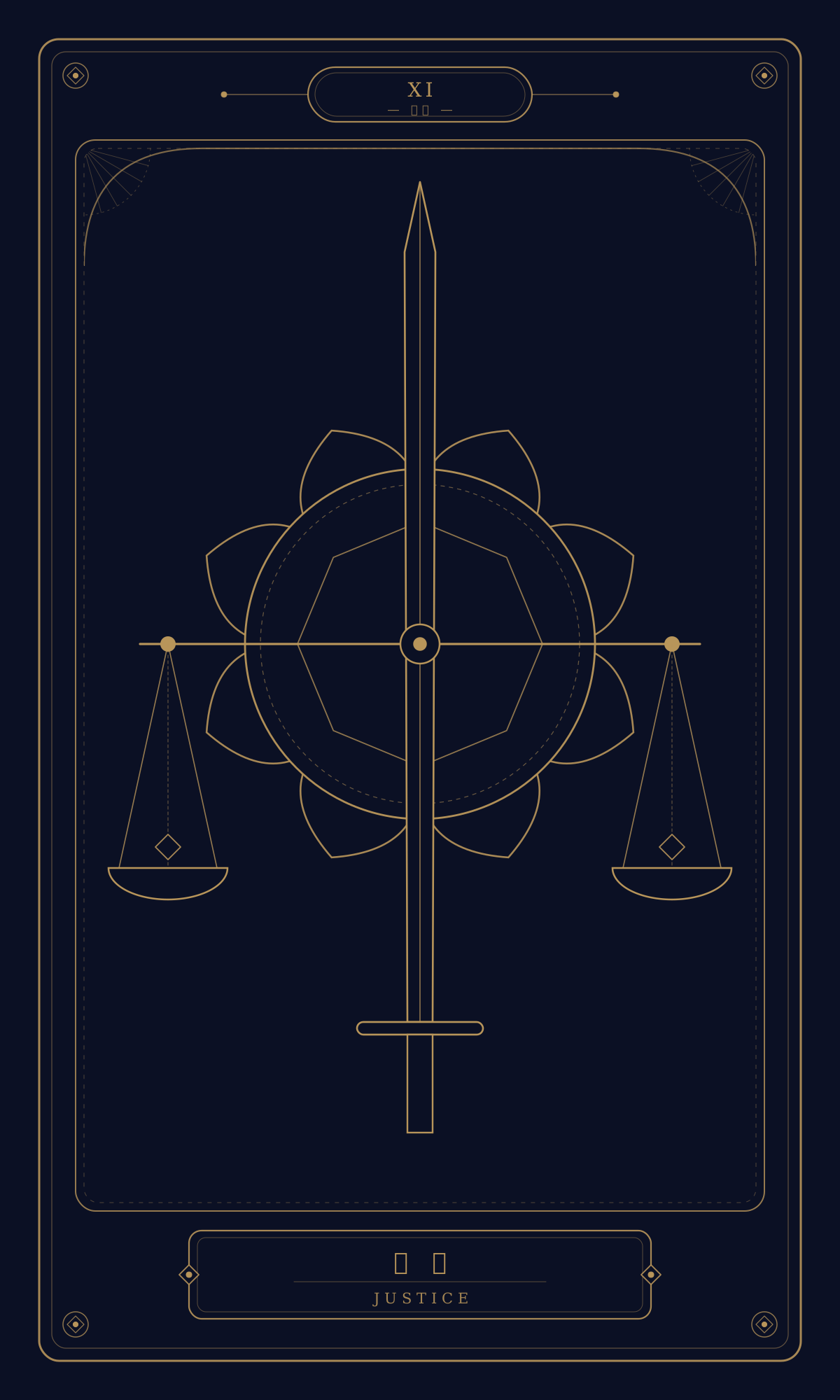
In a word (upright)
A time to judge things fairly and calmly. Don't get swept up by emotion—check the facts one by one, and you'll reach the right answer. Those who have acted honestly will be rewarded. A good time for contracts and discussions too.
When it appears reversed
Balance may be off, and you may feel something is unfair. But reacting emotionally will complicate things. First sort out the facts and check whether you've overlooked anything on your side. Speak calmly and you'll be understood.
A starting point through the image
In the older guidebook's illustration, A seated figure between two pillars holds scales and an upright sword.
Use Fair-mindedness · Judgment · Balance as a clue when considering something on your mind. A figure in the image need not represent someone of a particular age or gender; it can also symbolize a role held by you or someone around you.
Upright meaning
Place feelings and facts on the same table and align choosing criteria. Fairness is more than asking everyone for identical amounts. Check available time and existing responsibilities too. When explaining, retain one basis for judgment. Give the next promise words both can understand in the same way.
This position focuses on asking again about one condition you took for granted. Before rushing to decide whether it is right, return to the basis on which you judged it.
Reversed meaning
This is a time to look at whether the standard for judging changed along the way, or is being applied strictly only to yourself. For a matter you find hard to accept, you can split it into impressions and conditions you can verify. Before arguing over the conclusion, there is room to ask just one question about how it was decided.
Choose a rule difficult to accept and write whom to ask about which condition.
Love and relating to your partner
This is a time to think about equality not only by how often you meet, but also by who handles the messaging and the planning. If the same person always decides, you can swap roles just for the next time and ask what conditions are hard for each of you.
Consider the matter on your mind through Your own wishes and the promises you share. List separately what the person has actually said and the wishes you have not yet checked; this can help you choose a starting point for the next conversation.
In work and learning
Align the basis of decisions about requests or evaluations. Record responsibilities, deadline and finished state alongside decisions. For unknown conditions, choose one check before replying.
For a current task, the perspective is to clarify The role you accept and conditions you want to retain to continue. Focus on one step you are responsible for and first agree who needs to decide what.
When this card appears in a three-card spread
In the position for support and conditions to clarify, This position asks whether the list of things to check has grown too broad. Choosing the one point needed for your current question can narrow the person or material to consult next.
In the position for a next step you choose yourself, For your next step, place one question before the decision. Record what you learned in a line, then compare the available conditions again.
For a reversed card, use its reversed meaning and action above, then revisit the conditions to check in the same position. Rather than deciding an outcome from the card's name, consider the adjacent cards and the question selected beforehand together.
One thing to take into daily life
For an uncertain judgment, place one verified fact beside one standard you want retained.